
Marketing Automation vs AI Agents: What's the Real Difference?

CTO



Key Insights
- Automation scales tasks. Agents scale strategy. Rule–based automation executes what you define. AI agents reason, adapt, and make decisions in real time.
- Neither replaces the other. The most effective B2B marketing stacks use automation for predictable tasks and agents for strategic, adaptive work.
- Brand consistency at scale requires architecture. A dedicated brand guardian agent with deep memory is the most reliable way to maintain voice across high–volume content.
- The transition is faster than you think. With the right architecture, B2B teams can have their first AI agent–generated content live within 30 days.
- The market has already moved. The global AI agents market is valued at $11.78 billion in 2026, growing at 46.6% CAGR – this is a structural shift, not a speculative one.
If you use HubSpot, Marketo, or any modern platform, you already rely on marketing automation. Scheduled emails. Lead scoring rules. Workflow triggers that fire when a prospect downloads a PDF. It works – and it should keep working.
But something has shifted. A new category of technology – marketing AI agents – is being positioned as the next evolution of marketing automation. The claims are bold. The terminology is often muddled. And the question most B2B marketing leaders are actually asking is quietly practical: do I need to change anything?
This article gives you a clear, honest answer. We will cover what marketing automation actually does, where it stops, what agentic AI unlocks, and – critically – how the two technologies work together in the highest–performing B2B marketing stacks.
What Marketing Automation Does (and Where It Stops)
Marketing automation is built on a simple and powerful idea: if you can define a rule, you can automate the action that follows it.
A contact fills in a form → send a welcome email. A lead reaches a score of 80 → notify Sales. A contact has not engaged in 90 days → move to a re–engagement workflow. These are predefined workflows operating on structured data, and they execute reliably at scale without human intervention.
This is genuinely valuable. Rule–based automation removes manual repetition, ensures consistent follow–up, and gives marketing teams leverage across large contact databases. For predictable, mappable tasks – scheduled sends, form routing, lead scoring, CRM updates – automation remains the right tool. HubSpot's marketing statistics research consistently shows that teams using marketing automation report higher lead quality and shorter sales cycles compared to teams that do not.
But automation has a ceiling. It can only do what you have anticipated and configured. Every scenario requires a rule. Every edge case requires an update. As your marketing grows more complex – more channels, more audience segments, more content types – the rule set multiplies. The system becomes brittle. And crucially, automation scales the execution of known tasks. It does not scale strategic thinking.
Here's the thing: a marketing automation platform is a delivery mechanism. It is exceptionally good at moving structured data through predefined pathways – but the moment the input is unstructured, unexpected, or requires contextual judgement, it stops. That ceiling is not a flaw in the technology. It is the boundary of the problem it was designed to solve.
What Marketing AI Agents Do (That Automation Can't)
AI agents operate on a fundamentally different principle. Where automation follows rules, an AI agent perceives its environment, reasons about the best course of action, and acts – often without a predefined instruction for that specific situation.
Give an automation tool an objective it hasn't been configured for, and it fails silently. Give an AI agent the same objective, and it reasons its way to a solution at runtime.
This is what makes agentic AI different from the previous generation of AI–assisted tools. These systems can make decisions across unstructured inputs and adapt in real time as conditions change.
In practice, marketing AI agents unlock capabilities workflow engineering cannot: parallel content creation, dynamic responses to new signals, specialist coordination, and brand–consistent output at volume.
At Jam 7, our Growth Agents have worked with B2B tech brands that moved from single–digit monthly content output to 20+ pieces per month within 90 days, without adding headcount and without compromising brand voice.
The Core Difference: Tasks vs Strategy
This is the sharpest way to understand the distinction – and the most important one for B2B leaders evaluating their martech stack.
Marketing automation scales execution. It takes tasks you have already defined and runs them faster, more consistently and at greater volume than a human team could manage manually. The ceiling is the quality and completeness of your rule set.
AI agent architecture scales both execution and strategic thinking. Agents can handle novel inputs, make judgement calls, adapt campaigns in real time, and coordinate across multiple work streams – while maintaining brand memory and context needed to produce coherent, high–quality output.
| Capability | Marketing Automation | AI Agent Architecture |
|---|---|---|
| Executes predefined workflows | ✅ Yes | ✅ Yes |
| Adapts to unstructured inputs | ❌ No | ✅ Yes |
| Makes real–time decisions | ❌ No | ✅ Yes |
| Maintains brand memory across content | ❌ No | ✅ Yes (dedicated brand agent) |
| Runs parallel campaigns without additional headcount | ⚠️ Limited | ✅ Yes |
| Scales strategic output | ❌ No | ✅ Yes |
The distinction is not academic. For a B2B SaaS marketing team producing content across five personas, three funnel stages, and multiple channels simultaneously, automation handles delivery whilst agents handle intelligence. Gartner's marketing technology research identifies this capability gap – between marketing automation and strategic intelligence – as the defining architectural challenge for modern marketing functions.
Agentic AI Marketing: Specialist Agent Mesh
Most descriptions of AI agents in B2B are generic – "an agent that drafts content" or "an agent that analyses data." This misses what makes agent architecture powerful: specialisation and coordination.
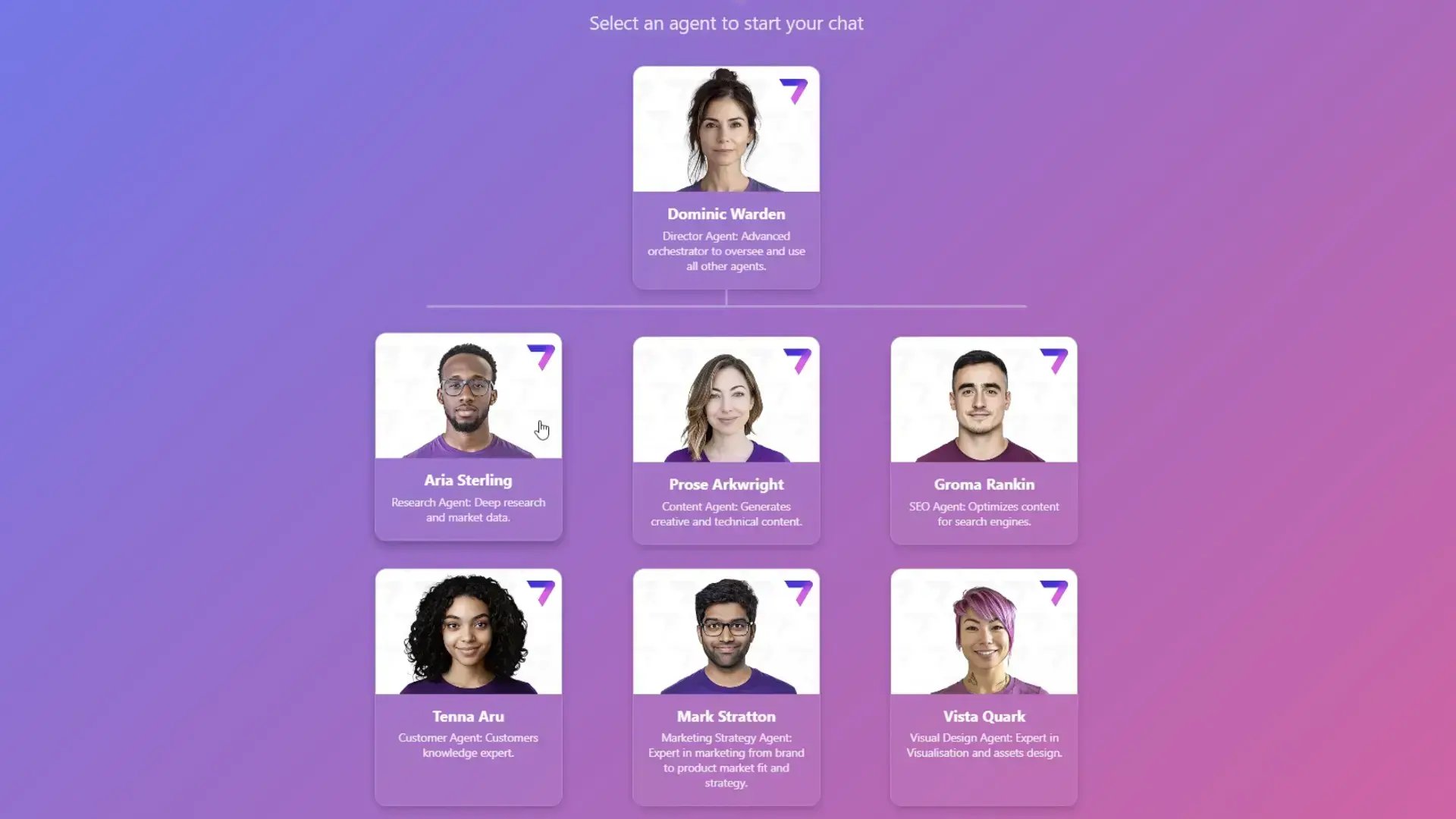
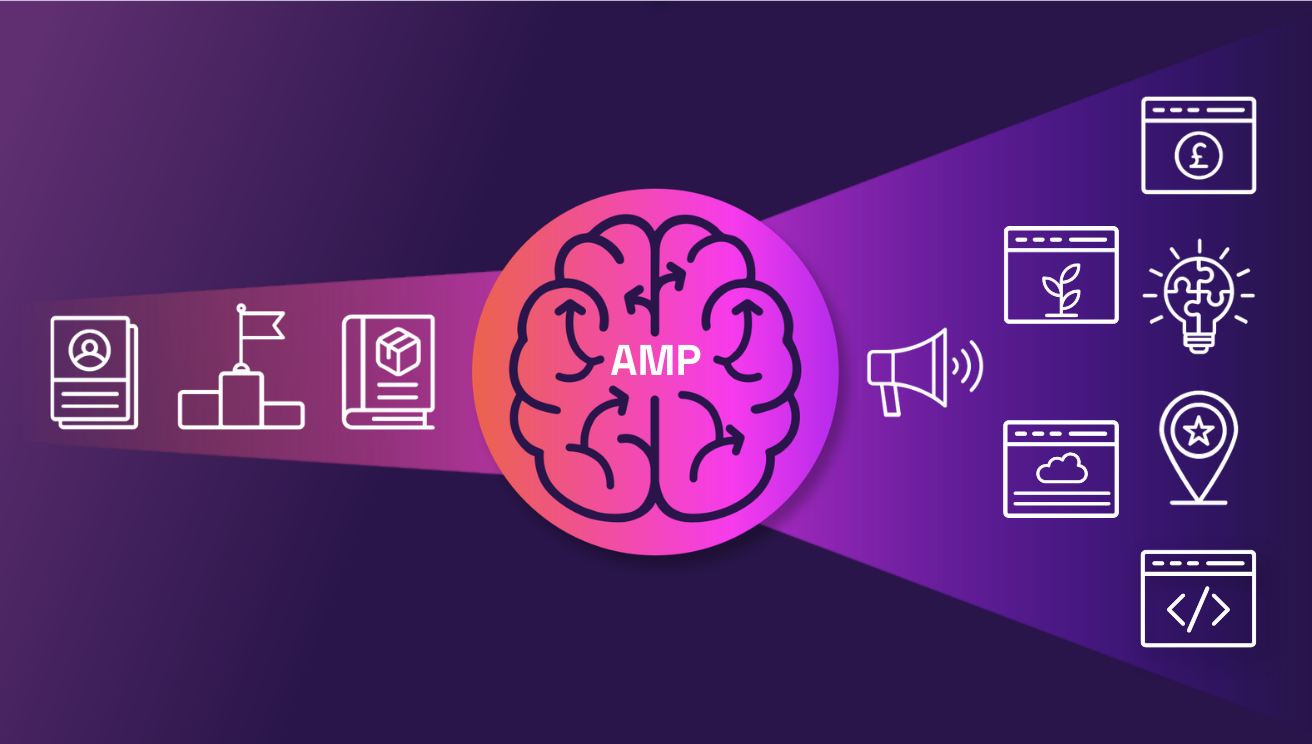
Jam 7's Agentic Marketing Platform™ (AMP) is built on a specialist agent mesh – a coordinated team of named agents, each with a defined domain of expertise, working in parallel and sharing context through a centralised content management knowledge base.
- Aria conducts deep market research, identifying signals, competitive gaps, and audience intent
- Brena holds and guards brand memory – tone, messaging, positioning – ensuring every piece of output is consistent regardless of volume or channel
- Prose produces the copy: blog posts, emails, landing pages, social media posts
- Groma owns performance: paid search, paid social, campaign architecture
- Cresca manages campaign coordination across channels
- Taya handles customer insight and lifecycle intelligence
This is not a single AI marketing tool processing one request at a time. It is agent orchestration – multiple specialist agents running in parallel, sharing a common brand memory, delivering output that neither a single AI tool nor a single human team could match at pace.
The human–in–the–loop remains essential. A senior strategist sets direction, approves output, and refines the knowledge base over time. The agents amplify that expertise – they do not replace it. This is precisely what Martech.org describes as the defining characteristic of agentic AI: it augments human strategic capacity rather than simply executing predefined instructions.
For a full explanation of the specialist agent architecture, see Your Marketing Brain Scales Infinitely. Your Team Doesn't Have To.
When Marketing Automation Software Fits
Honesty matters here. Marketing automation is not being superseded – it is being complemented.
There are categories of work where rule–based automation is clearly the superior choice:
- Transactional and lifecycle emails – welcome sequences, trial expiry reminders, renewal notices
- Lead scoring and routing – structured criteria applied consistently across a large contact database
- Form–to–CRM workflows – reliable, predictable, and requiring zero judgment
- Scheduled nurture campaigns – predefined content delivered to defined segments on defined timelines
If a task can be fully mapped in advance, marketing automation executes it reliably and cost–effectively. The moment judgment, adaptation, or creative output enters the picture, the calculus changes.
What makes automation genuinely powerful is its precision and reliability at scale. A marketing automation system does not have bad days. It does not misinterpret the brief. It executes the rule, every time, without error. That is an extraordinary capability for the right category of work – and smart B2B marketing teams protect it by not asking automation to do work it was never designed for.
The Salesforce State of Marketing report notes that high–performing teams are more likely to have clearly defined boundaries between their automation workflows and AI–assisted production processes. Teams struggle when they over–rely on automation and hit the ceiling, or abandon it entirely and lose operational reliability. The winning architecture keeps both – each doing the work it was built for.
When AI Marketing Tools Fit
Marketing AI agents come into their own when the inputs are unpredictable, the context matters, or the strategic stakes are high.
- High–volume content production that must maintain brand voice and topical relevance across channels
- Real–time campaign adaptation in response to competitor activity, market shifts, or customer behaviour
- Parallel workstreams – running three campaigns simultaneously without tripling headcount
- Brand–consistent personalisation at scale – relevant content tailored to specific target audiences without briefing a writer for each variation
- Strategic content planning informed by live trend data, search intent, and competitive intelligence
The always–on model – where content answers customer questions continuously, not just during campaign windows – is only viable with agentic AI marketing architecture. No human team and no automation rulebook can maintain that cadence.
How They Work Together
The question is never "automation or agents?" The question is: what does each do best?
The winning B2B growth stack uses both. Marketing automation handles predictable, repetitive tasks such as workflow triggers, lead management and reporting. AI agents handle intelligence, adaptation, and strategic output across multiple channels.
For B2B SaaS teams moving from an automation–heavy setup to an agentic AI marketing architecture, the transition does not require ripping and replacing. Jam 7's AMP onboarding runs across 90 days: 30 days of brand discovery, 30 days of testing and calibration and 30 days of production at full pace.
Automation helps you answer consistently. Agents help you answer better, at a pace that turns strategy into momentum.
Explore the full specialist agent architecture →
Ready to Add Intelligence to Your Stack?
If you are evaluating whether AI agents belong in your marketing architecture, the starting point is not technology – it is brand discovery. Book a 30–minute session with Jam 7 to understand what your marketing engine could look like with a specialist agent mesh working alongside your existing marketing automation.
Frequently Asked Questions
What is the difference between marketing automation and AI agents?
Marketing automation uses rules and structured customer data to run predefined workflows, such as email campaigns, lead generation scoring, and handoffs to the sales team. AI agents reason over context, customer behaviour, and unstructured inputs to decide what to do next. Automation scales repetitive marketing tasks. Agents scale strategy.
Can you explain the key features to look for in marketing automation software?
Look for workflow flexibility, strong segmentation and reliable triggers across channels like email marketing automation and social media posting. The best platforms also support clean CRM sync, consent controls, analytics and advanced features like dynamic content, subject line testing and lead scoring. Watch the learning curve as you add more automations.
What are some popular examples of marketing automation tools?
Common marketing automation solutions include HubSpot, Marketo, Pardot (Salesforce), ActiveCampaign, and Mailchimp. Some teams also use Klaviyo for ecommerce, and automation software capabilities inside customer data platforms. The best fit depends on your customer journey, the complexity of your lead nurturing, and your broader marketing efforts.
How do I choose the best marketing automation platform for my business?
Choose based on your customer journey, your marketing strategy, and the quality of your contact data. Prioritise ease of use, CRM fit, and how well it supports lead generation, lead nurturing, and reporting for your sales team and customer support. Then validate with one pilot workflow and measurable marketing effectiveness.
What steps should I follow to set up marketing automation for the first time?
Start with one use case tied to customer interactions, such as a welcome series, an abandoned cart email, or lead qualification. Map the customer journey, clean contact data, and connect your CRM. Build a small set of instructions, test edge cases, and monitor website visits, conversions, and sales activities. Expand once you see better results.
Can AI agents replace marketing automation?
No – and any vendor claiming otherwise deserves scrutiny. Marketing automation and AI agents are optimised for different categories of work. Automation excels at predictable, repeatable tasks that can be fully mapped in advance: scheduled emails, lead routing, CRM updates, and lifecycle triggers. AI agents excel at judgment–intensive work: real–time adaptation, brand–consistent content at scale, strategic orchestration, and multimodal decision–making. The most effective B2B marketing architectures use both – marketing automation as the reliable operational layer, agents as the intelligent strategic layer on top of it. Replacing automation with agents would be like replacing your accounting software with a strategist: both valuable, neither interchangeable.
Do I need AI agents if I already use HubSpot or Marketo?
Yes – because HubSpot and Marketo solve a different problem. Your marketing automation platform handles delivery: sequencing, triggers, routing, and reporting. What it cannot do is produce brand–consistent content at scale, adapt campaigns in real time, or run parallel strategic workstreams without proportionally expanding your team. Marketing AI agents handle the creative, strategic, and adaptive layer that automation platforms were never designed to address. The two work together: automation delivers; agents think, create, and adapt. Reviewing G2's marketing automation category will show you what the leading platforms do well – and where every one of them reaches its limit.
How do AI marketing agents maintain brand voice across high–volume content?
Brand voice degradation is the most legitimate objection to AI–assisted content at scale, and it is one worth taking seriously. The answer is architecture, not optimism. Jam 7's approach uses a dedicated brand guardian agent – Brena – trained during a 30–day brand discovery process on every dimension of a client's voice: tone, messaging, terminology, positioning, and examples of approved and rejected content. Every agent in the mesh draws from this shared brand memory before producing output. Human review gates at key stages ensure the system remains calibrated. The result is brand consistency that does not degrade with volume – it is structurally enforced rather than hoped for. This is the difference between a brand that scales and one that simply produces more content.
What are the limitations of traditional marketing automation?
Traditional marketing automation requires a rule for every scenario. As B2B programmes expand across channels like social media and email marketing, the number of repetitive tasks and edge cases grows fast. Without strong customer data and clear best practices, workflows become brittle and degrade customer experience.
As B2B programmes grow more complex, the rule set becomes increasingly difficult to maintain. The platform cannot adapt to inputs it has not been configured for. It cannot exercise judgment. It cannot produce original content. And critically, it scales task execution without scaling strategic thinking behind those tasks. The Martech.org analysis of agentic AI makes this structural distinction clear.
How quickly can a B2B marketing team implement an AI agent architecture?
Faster than most teams expect. Jam 7's AMP onboarding follows a structured 90–day path: the first 30 days focus on brand discovery – training the agent mesh on the client's voice, positioning, personas, and existing content. Days 31–60 are testing and calibration, with first content live and reviewed. By day 60, the full agentic AI marketing architecture is operational at velocity. This timeline assumes active participation from one senior internal stakeholder and no pre–existing infrastructure changes. The majority of clients see their first agent–produced content in production within 30 days of starting – well ahead of the timelines most teams anticipate when they first evaluate the shift from automation–only to a combined automation and agent stack.
Your competitors are answering. Are you?
Get your prioritised growth audit in 5 minutes. See exactly where you're losing trust, and how to win it back with Speed, Scale, Consistency, and Credibility.